
|
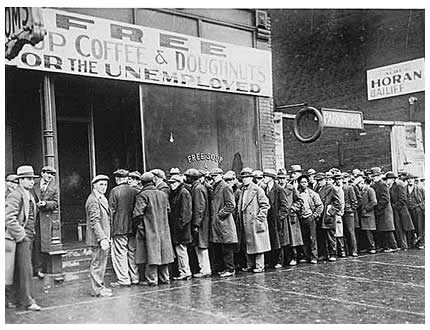
Women - Weak and Pathetic? I was incensed very many years ago to find that my mother had been forced to give up a good teaching job when she married my father, in the 1930's. She was a woman who clearly needed something beyond the family to give her some interest in life. (She wasn't typical, for those days.) And she clearly suffered later by not fulfilling her potential in this respect. It annoyed me that she had been discriminated against purely and wholly on the basis of her gender, and particularly so given that she was well-known to be very good at her job as a teacher. It seemed extremely unfair. My father explained the reasons in this way. Within communities in those days, there was a great deal of unemployment. Indeed, there was not much in the way of 'industry'. Families were seen as economic units with responsibility for looking after themselves, and it simply was not tenable for one family to have two wage earners in the house while the next door neighbours had none. Such a thing would have been a recipe for social envy, disaster and violence - and, of course, in those days, there was no particularly effective welfare system to balance the imbalances.
Neither was there much of a police force; which meant that social unrest or disharmony would very quickly lead to real problems. For example, the poorer would have been able to rob those who were seemingly wealthier with impunity. And why not? - if their families had no wage earners and very little food, while the CHILDLESS couple NEXT DOOR had TWO wage earners, food and even luxuries. upon marriage, either the husband or the wife had to stop work. So, the convention was that, upon marriage, either the husband or the wife had to stop work. Since the wife was very likely to have children (and, in this case, she did - me and my sister) custom and convention dictated that she was the one who should stop working. The overwhelming majority of women did not see this as discrimination. They saw themselves as being lucky enough to have a system which allowed just about each of them to collar a man prepared to go out and earn a living in order to support her and her children. Further, prepared to or not, like it or not, the man was EXPECTED to do this, by the monumental social pressures that societies typically exert through tradition and custom - and, in many cases, through the law.
Frank Sinatra was indicted for failing in his promise to marry a young woman whom he had, allegedly, 'seduced' Indeed, as an example, in the USA, it was around this time that a young Frank Sinatra was indicted for failing in his promise to marry a young woman whom he had, allegedly, 'seduced'. He was only saved from prison when she withdrew her complaint. Given that most women had MANY children fairly vicariously in those days, and would end up spending many years looking after them, it was also silly to invest a country's, or a family's, very limited wealth in the education of women - because they were the very ones most likely NOT to take any value from it. Further, it was clearly best for everyone that females, when children, spent much of their time being trained for motherhood rather than being prepared for something that was very unlikely to happen - like a having a full-time 'career', or a job, of whatever sort. Also, looking after children in those days was somewhat more time consuming, more complex an affair, and far more laborious than it is today. There were no microwave ovens, washing machines, fridges, vacuum cleaners, telephones, televisions, automatic heating systems, cars, etc.. And there was little in the way of modern materials, medicines and chemicals that we now rely on so heavily.
Cooking, cleaning, clothing and child-rearing were, therefore, major domestic industries Cooking, cleaning, clothing and child-rearing were, therefore, major domestic industries in themselves, and preparing young girls for dealing successfully with all of these things was crucial for their well-being and for their survival in the rat race. Moreover, and MOST IMPORTANTLY, societies that did not do this were not going to succeed in the face of competition from those that did. In terms of cultural 'evolution', therefore, societies whose women did not care properly for the children, while the men laboured on their behalf, never made it. Indeed, such societies would have disappeared very quickly - as more effective ones took over the land. And you can see this sort of thing happening even today. For example, there are now many pockets in Britain today where women are, indeed, failing to bring up their children properly, and where the fathers are - thanks to feminism - 'not required'. across the entire country, there are vast areas where young delinquents terrify the inhabitants And, as a result, across the entire country, there are vast areas where young delinquents terrify the inhabitants and where criminality is the norm. And the activities of these young anti-social individuals spill out to affect the rest of British society.
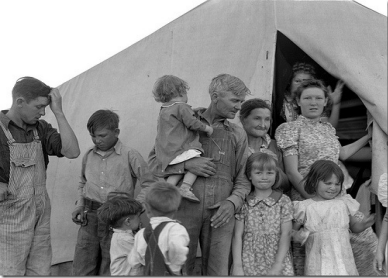
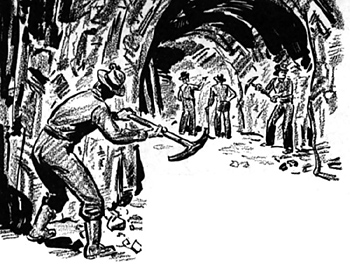
These pockets of deprivation, which they have now become, all have something in common. They are places where a significant proportion of the fathers are absent or ineffective. And it doesn't take more than a handful of their dysfunctional offspring to terrorise and ruin entire neighbourhoods. Yet they survive - but only because the rest of the country keeps injecting millions of pounds into them and because it is prepared to provide them with so many supportive services - police, health, education etc. Without this support, they would fail. Indeed, they would destroy themselves. And this is exactly what would have happened in the past. In fact, even now in the UK, areas have literally had to close down, so bad and uninhabitable had they become. The best road to success in the past was for women to bring up the children - and to be trained to do so properly - while the men spent much of their time developing the environment and tapping its resources, giving just some of their time for helping out with the rearing of their own children - particularly the boys. And it wasn't only men who enforced these 'decisions' and norms, it was WOMEN. And I saw this with my own eyes during my own early life. Indeed, if the men had been given their way, many would have been more than happy to have their daughters and wives working out there - for money - in order to help to pay the bills. But, I repeat, it would have been a recipe for social disaster for one family to have both parents earning while their neighbours had no income at all. Given that women were biologically chosen by nature to be the ones to bear children and nurture them, it is hardly surprising that, throughout all of History, in all other areas, they have been 'held back'. They have simply had other things to do. And for feminists to keep blaming men for what Nature gave to women is pointless, hysterical and malicious. Indeed, if anything, the men of the past should be recognised for having devoted most of their waking hours to working (or, rather, slaving) in order to support their loved ones. what this deceitful and gullible group of women describes as 'oppression', was, in reality, men trooping out to work, day in, day out, While misandric feminists like to portray men as having oppressed women by 'keeping them at home with the children', it is clear that both genders benefited hugely from the deal. The WHOLE of society did. Further, what this deceitful and gullible group of women describes as 'oppression', was, in reality, men trooping out to work, day in, day out, often to the most awful jobs imaginable, in order for their families to survive as best as they could. And if you younger folk in any way imagine that the jobs of men, 100, 200, or even 50 years ago, were, in any way, comparable to the jobs of today, you are poorly educated indeed. They were awful - and, at the very best, utterly tedious. And the hours were long with very little in the way of good transport to convey them to work and back, and with certainly not much in the way of rights and pay.
Do feminists really believe that women would actually have preferred to do these jobs rather than stay at home with their children in the comfort of their surrounding friendly neighbourhoods? Here's an extract from David Thomas' book Not Guilty ... During that period, the proportion of women in paid employment dropped from 75 per cent to 10 per cent. This was regarded as a huge step forward for womankind The desire to free oneself from work was common to all classes and both sexes. Dr Joanna Bourke of Birkbeck College, London, has studied the diaries of 5,000 women who lived between 1860 and 1930. During that period, the proportion of women in paid employment dropped from 75 per cent to 10 per cent. This was regarded as a huge step forward for womankind, an opinion shared by the women whose writings Dr Bourke researched. Freed from mills and factories, they created a new power base for themselves at home. This was, claims Dr Bourke, "a deliberate choice. . . and a choice that gave great pleasure." In other words, during that period, women did not like the jobs that were available, and so they opted out of them. The men had to do them instead. The belief that women have been oppressed throughout History is only true to the extent that EVERYONE was oppressed by somebody else. For example, for every miner who 'oppressed' his wife at home, there was another man, an employer or manager, who oppressed 100 miners in the pits. And the idea that women were the only oppressed 'victims' in all of this is ridiculous, and completely beyond belief. One only has to look at the selfless way that men sacrificed their lives on the Titanic, where 'women and children first' was the order for escape and safety, to appreciate just how valuable the female gender was regarded by men in the recent past. This was the reality then, no matter what feminists will tell you about the 'oppression' and the 'low status' of women in those days. Indeed, if women had been truly oppressed and seen to be of low status, then they would have been oppressed right back into their cabins while the men escaped into the lifeboats. The idea that women ... have not had power throughout recent History is, of course, a feminist-inspired falsehood The idea that women, particularly western women, have not had power throughout recent History is, of course, a feminist-inspired falsehood, and it was created mostly by emotionally-deficient women to provide further fuel for their personal campaigns of hatred against men. Furthermore, the fact that, in the past, the women brought up the children, and, hence, the very next generation, gave them untold powers. Not only did they influence the values, beliefs and behaviours of the next generation, they also benefited hugely from the fact that their children, both sons and daughters, bonded very tightly to them, emotionally speaking. This was a tremendous 'investment' for their own futures which benefited them throughout their entire lives, well into old age and death - not only financially and emotionally, but in almost every possible way. This empowered them hugely. And the further fact that the fathers were so much engaged elsewhere, away from their families, gave the mothers at home even greater relative influence, power and advantage over the future generation. In fact, the men were often reduced to little more than slaves and wallets when it came to 'the family'. Thus, when it comes to shaping the generations that follow, there can be no question of which gender has, and has always had, real power. And so, if women of the past were truly 'oppressed' in any way, then it was with the full complicity of the women themselves. Further, if any group had come up with something better than 'marriage' then it, whatever it was, would have been dominating our formal social arrangements by now. Instead, the reality is that ALL other systems governing the relationships between males and females, particularly in connection with their reproductive roles - and there must have been some other systems that were tried out - have clearly failed abysmally. They never got very far. Not one of them turned into a strong successful society. Not one! Another example that is often cited as evidence for the oppression of women was the common 'inheritance' procedures, whereby the oldest son inherited the property - the land, the money, the title and the status. But was this really oppression, given the circumstances and limitations of the recent past and beyond? For example, what does one do when there is no enforceable, observable, common, sufficiently complex legal system to deal with matters of property - or title, such as 'King'? Well, the best route is surely the simplest one. You hand the property down to just one member of the family - the oldest one. You don't even have to choose, and so stir up hostility in the unchosen. No piece of paper is even needed to prove the deal (not that most ordinary people could have read it even if there was one). And there are no arguments over this and that. The first-born male is the solution throughout. Further, by keeping all the wealth in the hands of just one person, this ensures that the family's power base is not divided into smaller units which eventually dissipate into relative insignificance.
You only have to look at the situation in Afghanistan to see what happens when there is no definable, undisputable 'heir to the throne'. Different warloads rise up, all claiming their own legitimacy, and the country is torn apart by warring factions struggling for power. And the women are completely disempowered in the process. Buy why did the male rather than the female always have precedence? The answer is that the female is weak and pathetic in comparison to the male - and this was especially so in more primitive times and places where muscles were almost as important as brains. She also has the children to bear and to look after. Further, females will have spent much of their youth preparing for motherhood and all its ramifications. In other words, females had enough on their plates. And what hope would there have been for any social groupings that gave the most power to those members least capable of using it effectively? Well, they would have been rapidly outgunned by those that didn't do this. And so they would have quickly disappeared. And so it is that, on balance, both the men and the women benefited from the custom that gave the male control of the family's wealth and power. Indeed, even today, those groups that are still very much attached to 'the family' (such as found in many UK Asian communities) and the traditional roles contained therein, are doing exceedingly well in comparison to those where the 'family' is more loosely structured and where the men have, effectively, been disempowered. These latter groups (e.g. as found in many council estates) are failures, and they would disintegrate completely were it not for the fact that they are kept alive by tax burdens placed upon the rest of us. In conclusion, it seems that if any social groups from the past had handed more power to their women and less to their men, they would, quite simply, have rapidly disappeared. And, indeed, this is exactly what seems to be happening now. Feminist-dominated societies and cultures will soon be washed away Feminist-dominated societies and cultures will soon be washed away and completely over-run by those wherein women prefer to stay at home and have children. Very simple mathematics will demonstrate this. And given that white western women currently make up only some 5% of the Earth's population then, in 100 years time, they will barely exist at all. Feminism is an ideology that promotes self-extinction. It is a cultural and racial suicide pill. It has no hope of succeeding. It has no hope of surviving. And it is going to cause huge problems to western societies as they slowly continue to decay and decline under its malign and destructive influences. Boredom Is The Problem
Here are some women from 150 years ago explaining the problems that women face. The major problem seems to be that they are bored. Not oppressed, hard done by, violated or abused; as the today's lying feminists would have you believe. The major problem for these women was that they found life to be boring. So, the 'oppression of women' turns out to be that they had nothing to do. I could do with some of that kind of oppression! The link takes you to a whole book. It's not the easiest of reads, but worthwhile browsing through. Notice how the FEMALE author clearly, and throughout, acknowledges her belief that - in those times - it was the WOMEN who MOSTLY determined how matters for WOMEN should be. Here is another quote ... "And looking around upon the middle classes, which form the staple stock of the community, it appears to me that the CHIEF canker at the root of women's lives is the want of something to do." Reasons for and against the Enfranchisement of Women Barbara Leigh Smith Bodichon - a woman - writing in 1869 - 15 min - beautifully written - MUST READ, especially for UK readers. Her -> -> -> M-O-T-H-E-R <- <- <- would not allow her to study medicine, so she decided to study mathematics at Girton College ... and other 'oppressed' women of the past |
|
Pinched from the fabulous
Heretical Sex blog ...
Male Primogeniture
It is worth asking how we came to have a system of male primogeniture [the man, not the woman, becomes the 'boss'] in the first place. Evolutionary theorists might comment that humans are a member of the chimpanzee family, and as such, territories are held by a group of males, with females being exogamous, which is to say that they marry out; on marriage, they leave their parents' troupe, and go to join their husband's. This helps to promote genetic diversity. Exogamy is reflected today in the fact that married women take their husband's name, and property passes down the male line. In ancient times, when communities would find themselves threatened by other communities, they relied on the military for survival, and that means the males. The strongest male was simply the best person for the job. Females could not successfully challenge the alpha male in combat, and moreover, they were too biologically valuable to risk losing, as they constituted the community's ability to reproduce itself. Monarchy is an ancient institution, and it follows male primogeniture because in ancient times, the King was also the head of the army, and marched to war with his men. He was the gang leader, the godfather, the alpha male, the toughest kid on the block. There were many other men who wanted the job, and if they could topple him, they would. Very few women could survive for long in that environment, nor wanted to try. In those days, unlike today, women would have valued masculine strength. The real question is not “Why didn't women succeed to the throne on an equal basis with men?” What we should be asking is “Why did women ever succeed to the throne at all?” Those who managed to get themselves into power wanted to cling to it by any means, including passing it on to their children. A breakdown in the royal succession often led to civil war and foreign invasion, and everyone wanted to avoid that. The worst outcome for a monarch was to die childless. It is no surprise that the Royal daughters became Plan B. If the King had a daughter but no sons, then she would often succeed to the throne in order to maintain political stability. At the same time, do not imagine that Royal women in the past were passive idiots; they were just as rich and arrogant as the men, and they maneuvered on their own behalf. Male primogeniture, like much else in society, is a cultural reflection of human nature, not some sinister misogynist conspiracy. Male primogeniture, like much else in society, is a cultural reflection of human nature, not some sinister misogynist conspiracy. Feminists constantly bite the hand that feeds them. It is the effort of males over centuries which has created the relatively stable, rich and peaceful society which we currently enjoy. Women today can consider standing for political office, safe in the knowledge that they are not going to have to ride into battle carrying a sword, or be stabbed to death by a rival in their beds. The nature of leadership has changed. Rather than express gratitude for the comfortable and safe life which male-dominated society has provided for them, feminists can only complain. |
|
Also see, ... |




AH's RSS Feed
Recent comments from some emails which can be viewed in full here. ...
"I cannot thank you enough."
"I stumbled upon your web site yesterday. I read as much as I could in 24 hours of your pages."
"I want to offer you my sincere thanks."
"Your articles and site in general have changed my life."
"I have been reading your articles for hours ..."
"Firstly let me congratulate you on a truly wonderful site."
"I must say there aren't many sites that I regularly visit but yours certainly will be one of them, ..."
"It is terrific to happen upon your website."
"I just wanted to say thank you for making your brilliant website."
"Your site is brilliant. It gives me hours of entertainment."
"You are worth your weight in gold."
"Love your site, I visit it on a regular basis for relief, inspiration and for the sake of my own sanity in a world gone mad."
"I ventured onto your site ... it's ABSOLUTELY BRILLIANT, and has kept me enthralled for hours!"
"I love the site, and agree with about 98% of what you post."
"I have been reading your site for a while now – and it is the best thing ever."
"you are doing a fabulous job in exposing the lies that silly sods like me have swallowed for years."

On YouTube ...
Who Rules Over Us?
Part 1 On Free Will
Part 2 On Super-Organisms
Part 3 On Power
Part 4 On Reality
Popular articles ...
... War on Drugs - Who benefits from the war on drugs?
... A Woman Needs A Man Like A Fish Needs A Bicycle - Surely, the evidence would suggest otherwise.
... Why Governments Love Feminism - It is mostly to do with money and power, not equality.
... The Psychological Differences Between Men and Women - Are women really more emotional than men?
... Equality Between Men and Women Is Not Achievable - especially since Hilary Clinton said that, "Women are the primary victims of war."
... Cultural Marxism And Feminism - The connections between Cultural Marxism and Feminism.
AH's RSS Feed